The search for suitable employees is becoming increasingly complex and time-consuming for many companies. The young, sought-after talent of Generation Z in particular can hardly be recruited via print adverts – they simply no longer read newspapers and magazines.
Social networks such as Instagram, TikTok and Co. as well as business platforms such as LinkedIn and Xing, on the other hand, are omnipresent. There is hardly a digital native who does not have at least one account on one of these platforms. The conclusion of some pioneers in recruiting is obvious: Why not use social networks as a recruiting channel? A new form of recruitment was born: social recruiting.
Social recruiting – new possibilities for recruitment
Most companies are already active on social networks, but mainly for marketing purposes. Recruiters have only recently discovered the opportunities that social networks open up for recruitment.
Companies can also use their social media profiles to publish their job adverts. Business networks such as LinkedIn, for example, offer their own highly frequented job markets, and there are numerous apps for Instagram to create your own job market.
According to the softgarden study Candidate Experience 2023 1st part, 72% of applicants are open to job adverts that are displayed to them on social media. The majority of them prefer business networks such as LinkedIn or Xing for this type of approach. Read more about this in our study Candidate Experience 2023 Part 1: Job search, application process, personal media.
| Channel | Tends to apply | fully applies | both added together |
|---|---|---|---|
| 17,2 % | 64, 1 % | 81, 3 % | |
| 21,3 % | 38,1 % | 59,4 % | |
| 24,1 % | 16,7 % | 40,8 % | |
| 24,9 % | 23,1 % | 48,0 % | |
| TikTok | 7,9 % | 6,7 % | 14,3 % |
| Snapchat | 5,6 % | 4,7 % | 10,2 % |
| Spotify | 8,1 % | 6,3 % | 14,4 % |
Advantages of social media recruiting
Quick overview of CV details
Social profiles (especially Xing and LinkedIn) contain a person’s most important professional background and skills at a glance. This gives you the opportunity to view details of their CV without having to ask them to send it to you and only then realising that they are not a suitable candidate.
Easy access to candidates
Social media recruiting expands the possibilities for approaching suitable candidates. It usually takes just a few clicks to find a few interesting talents who you can write to via Messenger or contact using an email address provided. This approach (also known as active sourcing ) can also motivate passive seekers to apply.
Low costs
Social media recruiting can be extremely effective even with a small budget, especially with the skilful use of organic posts.
Organic posts, i.e. classic job posts, are quickly created, free of charge and offer enormous viral potential: A brief reference to the vacancy, supplemented by a link to the career page, can achieve a considerable reach through likes, shares and comments – without any advertising budget.
Tip: Involving employees as multipliers also increases visibility – keyword: employees as brand ambassadors in employer branding.
Although the free publication of job adverts on platforms such as Facebook is now restricted, organic reach can still be achieved on other networks such as LinkedIn, Instagram or X (formerly Twitter).
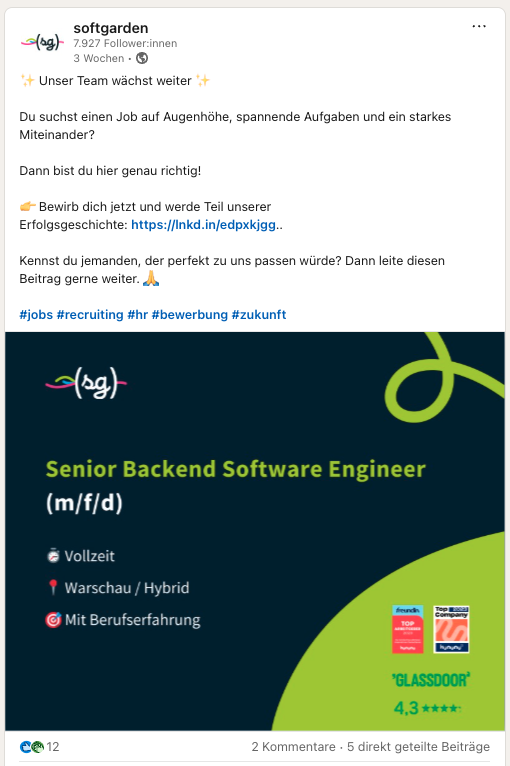
Paid adverts also offer the opportunity to address specific target groups – for example by location, industry or interests. Depending on the objective, advertising posts or the careers page can therefore be a useful addition to further increase visibility.
Social recruiting and employer branding
Another way of using social media is to present yourself as an attractive employer, known as employer branding. Social networks with their private character enable companies to communicate with their target groups at eye level and provide insights into everyday working life.
Good employer branding is particularly important for Generation Z, as the next generation places less value on big names and top salaries than on a good working atmosphere and flat hierarchies.
Social recruiting and active sourcing
Perhaps the most important aspect of social media recruiting, however, is the ability to search for talent independently and approach potential candidates directly (this approach is also known as active sourcing ).
Recruiters can use the user’s profile details, interests and communication style to assess whether the person they are targeting might be a good fit for their own company.
To avoid looking for a needle in a haystack, most social networks offer search functions that allow you to easily filter by specific criteria such as location and keywords like “WordPress programmer”. The LinkedIn platform, for example, offers AI-supported suggestions for suitable talents, which makes the search even more efficient.
Approach in social recruiting
But whether active or passive, it is important to use a convincing approach that is appropriate to the social networks. Social recruiters need a sure instinct for their target group: on social networks such as Instagram, the tone can be a little more “youthful” and “relaxed”; as a rule, people are on first-name terms.
Communication on business platforms such as LinkedIn varies depending on the target group: While the “you” is still the standard in traditional industries, younger target groups are increasingly favouring the “you”.
Target groups in social recruiting
Another important step for social recruiters is the right choice of networks, tailored to the needs of the company.
The current user numbers of Instagram and co. promise an enormously large talent pool on the one hand and a high reach of job offers on the other. Instagram, for example, has around 2 billion users worldwide, most of them in the coveted 18-34 age group. Instagram is therefore ideal for companies looking for career starters and young talent.
The business network LinkedIn, on the other hand, has over 850 million users worldwide, 22 million of them in Germany. The average age of its members is 25-34. Professionals from all sectors who are looking for jobs, employees, co-operation partners and business ideas network on LinkedIn.
Tips for successful social media recruiting
1. create company profiles on relevant channels
You don’t have to be present on all channels, but it is advisable to have a company website on LinkedIn and Instagram due to the number of users. You should definitely include all the important company details there that represent your company brand (the so-called employer brand). Remember to use keywords to appear as high up as possible in Google searches.
2. keep social media channels up to date
Remember to make a good impression on your target group. Outdated social media profiles are of little help here. Try to publish regular posts on all profiles and make them as target group-orientated as possible, i.e. post really interesting content. Indicators of this are the number of likes and clicks on individual posts or comments.
3. keep an eye on employee profiles
Potential applicants not only look at your company website, but often also at employee profiles to get an idea of the company. It is therefore beneficial to keep an eye on whether your employees have updated profiles, perhaps even with positive recommendations, which ideally lead to a positive overall image of your company.
4. targeted approach through precise target group selection (targeting)
To ensure that your job advert does not get lost in the social media stream, it is important to target the right candidates. This is exactly what so-called targeting enables – i.e. the precise selection of the target group for your advert.
With the Meta Ads Manager (for Facebook and Instagram), you can filter by age, place of residence, profession or interests, for example. This allows you to reach exactly the people who match your vacancy – even if they are not actively searching.
LinkedIn also offers job-related filters such as job title, career level or industry and is particularly suitable for specialists and managers.
The more precisely you know your target group, the more efficiently you can utilise your budget.
5. use of hashtags
When it comes to social media, there’s no getting round hashtags. By using these keywords labelled with a hash (#), your posts are more likely to be found and thus naturally liked and shared much more often.
If you are involved in social media recruiting, you should consciously decide on a set of hashtags and then include them in your posts.
1-5 hashtags per post are ideal (the use of too many keywords is again rated negatively by social media algorithms).
The first hashtag should have something to do with your company, while the second refers more to the specific job (e.g. “#telekomJobs”). The following hashtags can then be very broad again (“#hiring, #joinUs, #remoteJobs”).
6. targeted candidate approach rather recommended on career networks
When using the networks, you have to pay attention to what the respective users of the platform are looking for. Instagram and TikTok tend to be leisure networks where people mainly socialise with their friends and acquaintances and find out about job offers and companies on the side. It is therefore advisable not to write directly to candidates there.
In contrast to career networks such as Xing and LinkedIn. However, you should only write to specific talents with a personalised text and refrain from sending anonymous mass messages.
Especially when it comes to social media recruiting, it is advisable to work closely with your company’s marketing team, as they have the necessary experience with social media channels. In addition, social media is not only used for recruiting, but above all for employer branding. Everything has to work together to create a positive corporate image in the end.
Social recruiting with softgarden
Reach top talent where they are on the move every day – on Instagram, TikTok & Co.
With softgarden’s social recruiting software, you can target suitable candidates in social networks and place your job adverts directly in their feeds with just a few clicks.
You can find more information on our product page about social recruiting software.