A successful start often determines the long-term success of a company.
In this article, you will find out what onboarding really means, which phases it comprises and how you can integrate new employees in a structured, motivating and sustainable way. From preparation and induction to feedback culture – the article shows how a professional onboarding process strengthens employee loyalty, increases productivity and positively shapes the employer brand.
Table of Contents
Onboarding definition: More than just familiarisation
Onboarding describes the process in which new employees are integrated into a company and prepared for their role. The aim is for new team members to quickly find their feet and feel comfortable so that they can contribute their strengths as quickly as possible.
The onboarding process consists of several steps. It includes an introduction to the corporate culture, getting to know the team and relevant training for processes and tools. A well-structured induction increases the productivity of your employees and helps to ensure that talented people stay with your company in the long term.
Tasks and goals of onboarding
Onboarding should make it as easy as possible for new employees to join your company. The onboarding process includes various steps designed to familiarise your new employees with the company’s processes, tasks and values.
The most important onboarding tasks
- Preparation of the workplace: Provide relevant work materials, obtain all important IT access and request company equipment such as telephones or computers in good time.
- Communicate the culture and structure of the company: You should familiarise new employees directly with the most important values, working methods and special features of your company.
- Welcome meeting: Organise a welcome meeting with superiors and/or team members in which tasks and expectations are clearly formulated.
- Introduce the team: Introduce your new recruit to their new team and contact persons to promote integration and team cohesion.
- Explain work processes and IT systems: The better the initial briefing, the faster new employees will get to grips with your processes, tools and systems.
- Exchange feedback: Offer new employees regular opportunities for dialogue, especially in the initial phase. In this way, open questions and uncertainties can be clarified quickly before major misunderstandings arise.
An effective induction programme increases the motivation of your new recruits and your existing team. Those who feel well prepared and welcome will realise their potential more quickly.
Onboarding: importance for employee retention and satisfaction
The importance of onboarding for employee satisfaction is increasing, as confirmed by the latest softgarden study Candidate Experience 2023 – Part 2: The proportion of people who have already resigned in the first 100 days has been rising noticeably for several years.
The demands on the start in a new company are growing and the initial phase is increasingly becoming a “trial period for the employer”. A lack of leadership skills and inadequate induction plans are among the most frequently cited reasons for premature departure.
Successful onboarding, on the other hand, immediately creates trust and gives new employees the feeling that they are welcome and needed. As a result, they start their new role with motivation, integrate quickly and develop stable, long-term employee loyalty.
Levels and content of onboarding
Even though the induction process for new employees can vary depending on the industry and company, there are three key levels:
Technical level: At the technical level, you need to ensure that your new employees have the necessary knowledge, tools and access to their tasks. This includes training, IT briefings and detailed explanations of work processes.
Content level: This level is about communicating the culture, values and goals of your company. New employees should understand the “why” and “how” behind their daily work and be able to identify with it.
Social level: At the social level, the focus is on the human component. New employees should immediately feel at home and find their feet as quickly as possible. Clear contact persons help in the event of questions and uncertainties.
Make sure that your new team member is optimally integrated at all three levels. This will create the basis for a successful start to the new job.
Professional integration
The professional integration of your new employees is the basis for them being able to fulfil their role optimally. With a targeted induction programme, you can ensure that new recruits quickly find their feet in their role and understand the necessary processes. Communicate clear role expectations from the outset and use training to prevent uncertainty.
Content integration
Only if your new employees know the culture, values and goals of your company can they identify with them and make the most of their strengths. Make sure that this content is also communicated during onboarding, e.g. in the form of presentations or guidelines. Ideally, the new employee will be assigned a mentor/buddy who is available to answer any questions.
Social integration
The technical content and the company’s objectives are important, but they are not enough. A complete onboarding process integrates new employees, especially on a social level. Make sure that new employees feel connected from the outset and have the opportunity to integrate into their new team in the best possible way. In a positive working environment, new employees quickly feel at ease and are more motivated to work.
The onboarding process: the three phases of onboarding
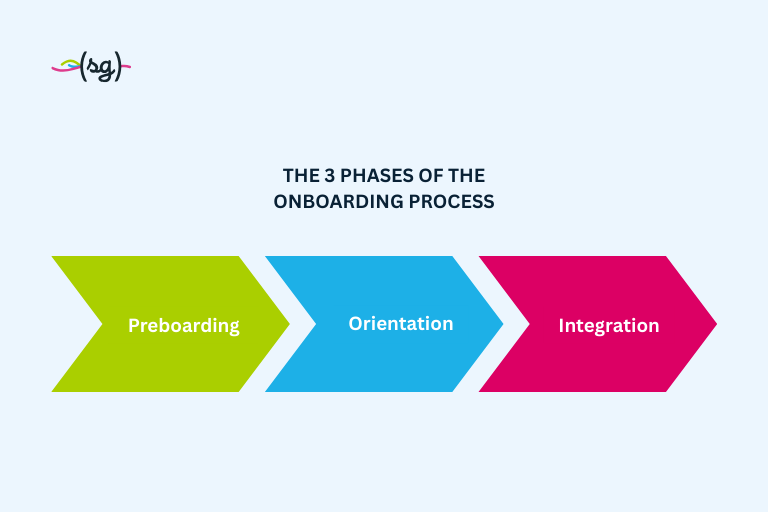
The classic onboarding process can be divided into three phases: Preboarding, orientation and integration.
Preboarding begins with the signing of the contract and ends on the first day of work. During this phase, you provide the new employee with orientation. The orientation phase begins on the first day and can last several months. Here you show the new employee their tasks and the processes within the team and the company. During the integration phase, the new employee is fully integrated into the team. This phase lasts several months – depending on the industry and complexity of the role.
Phase 1: Preboarding – Before the first working day
Preboarding covers the period from signing the contract to the first day of work and can take several weeks or even months. During this phase, the organisational foundations must be laid for optimal collaboration. This is where you clarify initial questions and slowly introduce the new employee to their new role. Make sure that all email addresses, tools and access points are ready, compile important information and send a welcome message to provide orientation and an overview. The more thoroughly you work in the preboarding phase, the easier it will be for your new employees to get started.
Phase 2: Orientation
“Where, what, who, how and when?” To ensure that new employees are not overwhelmed after just a few days, you need to give them guidance, especially at the beginning. During the orientation phase, you familiarise them with the new processes and tasks and help them to overcome any uncertainties. During this phase, they should get to know their new team. You should clarify expectations on both sides and assign the first tasks in order to quickly integrate the new team member. The orientation phase begins with the first day of work and usually lasts around three months.
Phase 3: Integration
The integration phase is about fully integrating new employees. They should become fully-fledged team members and utilise their full potential for the benefit of the company. This requires targeted feedback sessions, training and building trust between the new colleagues. The key to success here is the social component. Create a positive working atmosphere and make it as easy as possible for new employees to find their feet and identify with the company’s goals. The integration phase follows the orientation phase and usually lasts three to six months.
Reboarding: reemployment of employees
Reboarding is a special case of onboarding. This phase describes the process of reintegrating an employee into the company after a long absence. Examples of such absences include parental leave, sabbaticals, illness or the return of former employees.
In practice, reboarding is often neglected, although this phase of reintegration determines how quickly an employee finds their feet again and can work productively.
Optimised reboarding includes training on new processes and tools as well as introducing new colleagues and jointly defining the scope of tasks. In this way, employees quickly regain confidence.
Offboarding: Departure of employees
At some point, the time has come: offboarding describes the phase in which employees leave your company. A well-structured offboarding process makes it easier for everyone involved to say goodbye and ensures that the departure is positive and without friction. Offboarding includes returning company property, deactivating access and documenting all relevant procedures and processes.
You should also use the offboarding phase to gather feedback in order to further optimise your processes. With a professional farewell, your company leaves a good impression and increases the likelihood that the departing employee will recommend your company to others or even return one day.
Roles in the onboarding process
Successful onboarding is teamwork. New employees can only be integrated quickly if the various players in the company work together efficiently.
HR managers
You’re where everything comes together. You keep an eye on the entire onboarding process and take care of everything organisational: contract details, access data and important documents. You liaise with the relevant departments, prepare training sessions and act as the first point of contact.
Manager
The manager primarily takes care of the technical aspects. What is the role of the new employee and what exactly are their tasks? What are the work processes? What is expected? The manager clarifies all these points with the new employee and ensures a smooth integration.
Buddy/Mentor
Ideally, the new employee should be assigned a buddy or mentor as a contact person during onboarding. This role is best filled by an experienced employee who can help the new employee get started, clarify questions and uncertainties and facilitate integration into the new team.
Team members
The new team is crucial for the social integration of the new employee. If the team members ensure a positive start and a pleasant working atmosphere, trust will develop and the new employee will quickly feel at ease.
In an optimal onboarding process, all those involved are aware of their responsibilities and fulfil their tasks to ensure the rapid and positive integration of new employees.
If you know the expectations of applicants, you can optimise your onboarding processes. You can find out exactly what applicants expect from managers and new colleagues in our study Managers and colleagues in onboarding.
Onboarding measures
We have seen the importance of onboarding for the long-term success of a hire and we have looked at the different phases and roles involved. But which specific onboarding measures are most important? We have put together some key measures:
- Welcome pack with advance information: Your new employees should receive a pack with all the important information before their first day at work.
- Welcome and introductory meeting: A detailed welcome meeting with the HR managers and the relevant manager is essential. This gives new employees a good overview of the company and enables them to better assess expectations.
- Team introduction: A short team introduction in a relaxed atmosphere lays the foundation for the subsequent integration of new employees.
- Training and familiarisation: Familiarisation with important processes, systems and tools is a key part of the induction process. You should prepare relevant access and equipment in good time so that new employees can start without unnecessary delays.
- Regular feedback meetings: Regular dialogue with you as the HR manager and the respective manager is extremely important, especially at the beginning. It pays to listen carefully: this is how you find out whether the induction is progressing as planned. Open questions and uncertainties can be clarified at an early stage.
- Assigning a buddy or mentor : With a buddy or mentor, new employees usually find their way around their new environment more quickly and easily. The buddy should be given a clear area of responsibility and enough time for their work.
Onboarding software from softgarden
The importance of onboarding is often underestimated, even though it has a decisive influence on the long-term success of an employee: The impressions of the first 100 days in particular determine whether talented employees stay with the company in the long term or not.
Onboarding software helps you to optimise the onboarding processes in your company. This increases the likelihood that your hard-won new hire will stay with the company for as long as possible and really identify with your company’s success.
With the onboarding solution from softgarden, you cover all the crucial aspects and inspire your new team members with customised onboarding:
- Automated messages and process templates: Keep everyone involved up to date – at all times, fully automatically and personally at the same time. Automate routine admin tasks and gain more time for people.
- Multilingual welcome page: The welcome page also provides remote employees with optimal onboarding. Customise the page to match your company’s corporate design and flexibly activate internal information at the desired time.
- Transparent task distribution: Assign tasks automatically, inform about new tasks and track the onboarding progress of new employees conveniently online.
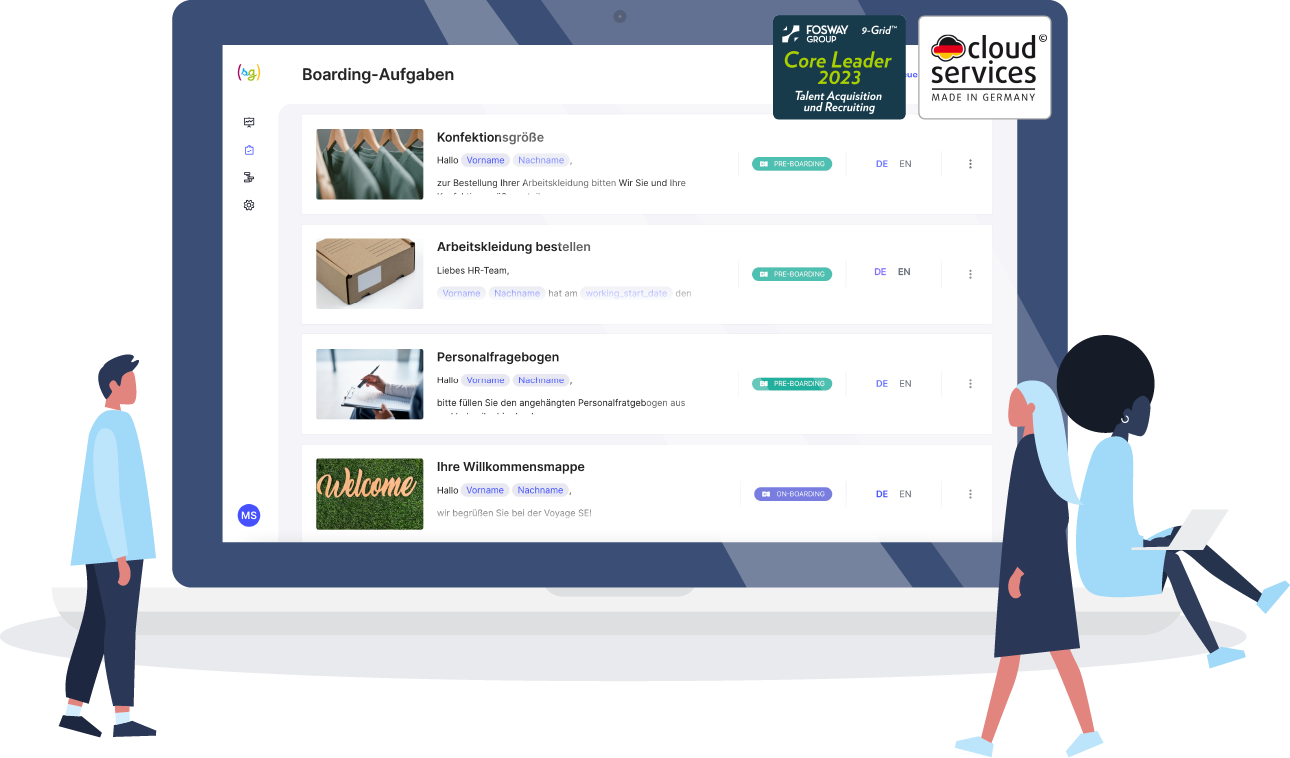
With softgarden’s onboarding solution, you can reduce induction costs, increase employee retention and ensure that your new hires realise their full potential for your company as quickly as possible.
FAQ – Onboarding
Onboarding is the phase of familiarisation and integration of new employees into a company. A good onboarding process covers the organisational, professional and social levels and ensures that new employees quickly feel at home and can work productively.
The purpose of onboarding is to make it easier for new employees to join the company so that they quickly find their feet and contribute their strengths to the company.
The three phases of the onboarding process are preboarding, orientation and integration. HR managers need to set different priorities in each phase in order to integrate new hires as well as possible.